
Edward Lear and Me
Translating Edward Lear’s limerick, now reborn with a Qajar beard and Iranian flair, as it slips into Persian and stirs up trouble!

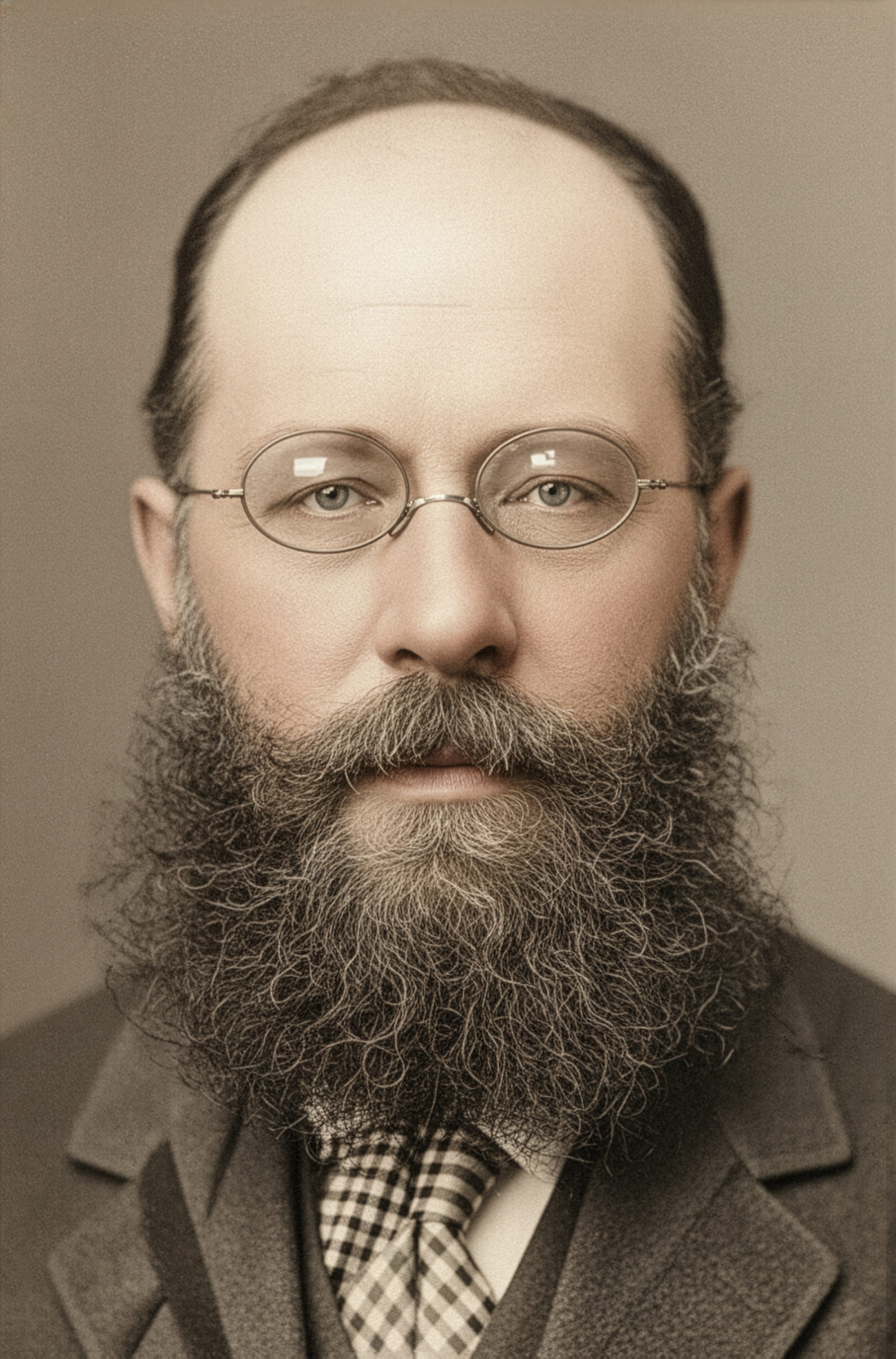
Edward Lear (1812–1888) has always felt strangely close to me. We share the same birthday, 12 May, and I have lived in the same part of North London where he was born. We also both suffer from asthma; he too knew the weariness that comes with fragile health. These coincidences make his story feel personal, as if traces of his eccentric spirit still linger in the streets I know. Lear was an artist, poet and master of literary nonsense, best remembered for his tender and absurd limericks and his illustrations.
And then there is The Owl and the Pussycat, his most beloved creation, a tale of improbable love and gentle rebellion. The owl and the cat set sail “in a beautiful pea-green boat”, leaving behind the rules of their worlds and travelling towards a place of play, affection and freedom. That voyage feels like Lear’s own: a passage from constraint into imagination, where longing and absurdity coexist.
My connection to him deepened when I translated some of his limericks into Persian and reimagined them through the art of the Qajar period (1789–1925). This was a time of change in Iran, when old traditions met new European influences. The Qajar era was full of colour and splendour, yet behind its beauty were strict hierarchies and limits that shaped everyday life.
Placing Lear’s nonsense in this world revealed unexpected echoes between Victorian England and Qajar Iran. Both were places where life was tightly framed by rules and appearances. Lear’s humour slips quietly beyond those boundaries, moving between sense and nonsense, sadness and delight. In that space, what is often left unseen becomes visible: loneliness, tenderness, contradiction. He turned the edges of experience into imagination and made nonsense a gentle kind of resistance.
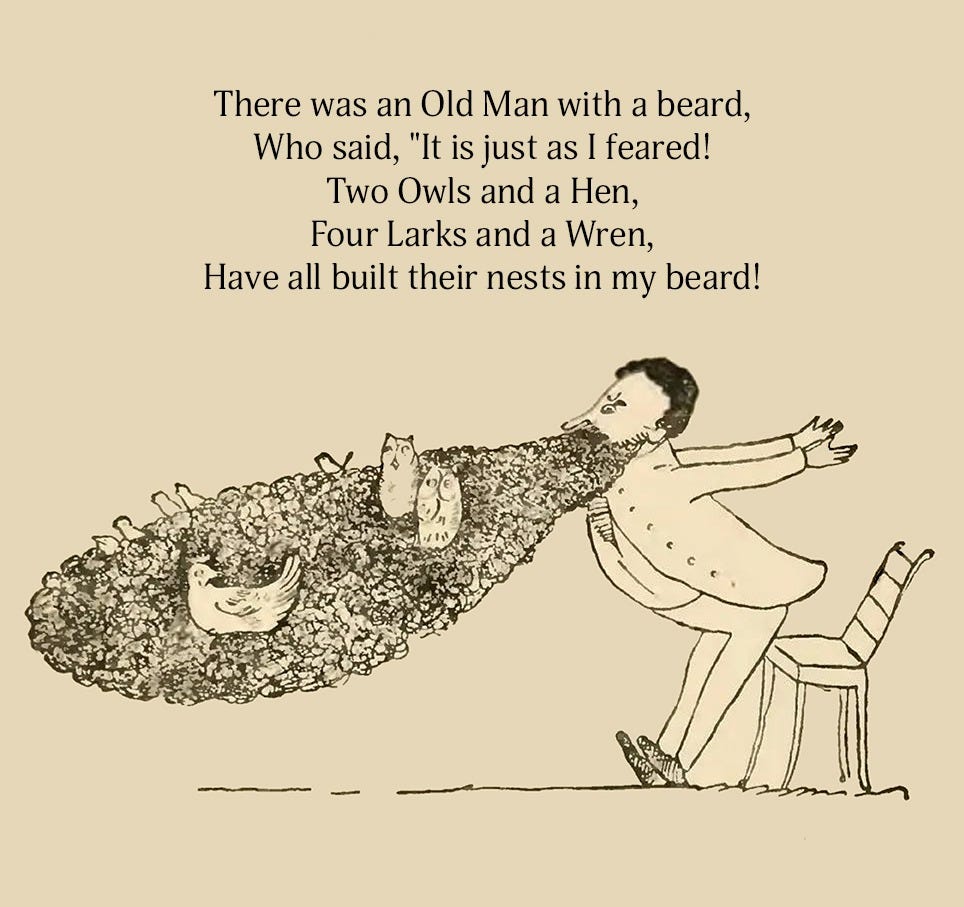
Above is one of my favourite limericks, and below is my own adaptation of it into Persian.
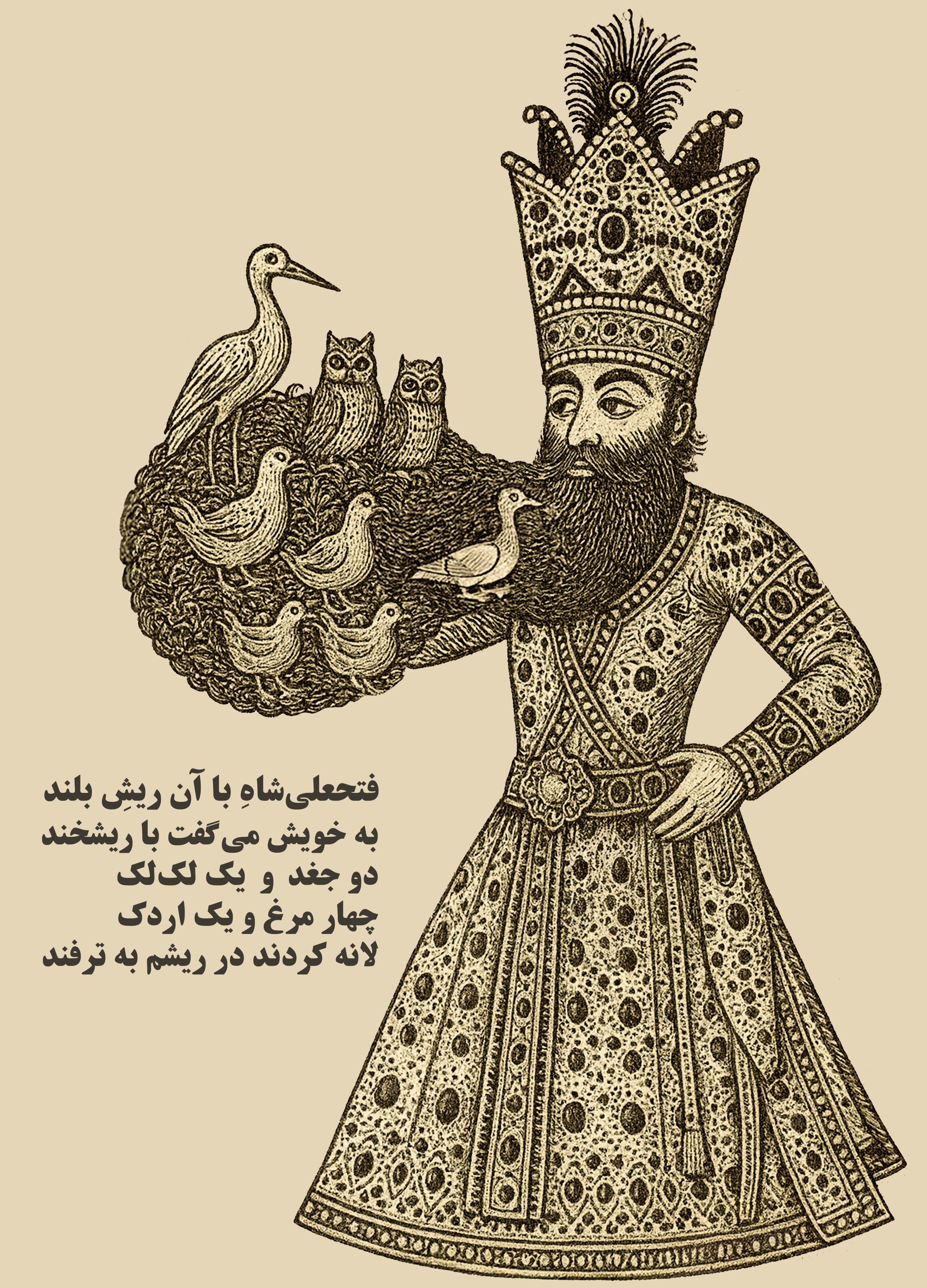
In the end, I chose Fath-Ali Shah because his famously extravagant beard invites exactly this kind of playful exaggeration. He has long existed somewhere between history and caricature, a figure whose self-fashioned grandeur almost asks to be reimagined. Transforming his beard into a nesting ground for birds allowed humour, satire and a touch of myth to meet in one image. It felt like a fitting way to close this reflection: a reminder that the boundaries between the real and the absurd are often far thinner than we think, and that sometimes a story reveals itself most clearly when approached with a smile.
© Mehrdad Aref-Adib 2025
Framed/Unframed is a reader-supported publication. Your support means a lot. You can become a paid subscriber, or help out for free by liking this post, sharing it, or sending it to a friend.