
Temporary Custodians
A Chance Encounter in North London and the Quiet History of Exile Within Its Walls

We live inside our homes as if we are the first to do so. We paint over the scratches, hang our own pictures, and the rooms begin to echo only with our voices. The past recedes and the walls seem to belong entirely to us. But sometimes history does not stay silent. Sometimes it waits outside.
It was an ordinary afternoon in October 2022. I was walking back from some shopping when I noticed two elderly men standing on the pavement outside our flat in Golders Green in North London. They were not passing by or checking directions. They were looking up at the façade with a stillness that felt almost ceremonial.
In London, we are conditioned not to engage. We avert our eyes and move on. But something in their posture stopped me. They did not look lost. They looked as if they had found something.
I went upstairs and told my partner. We watched them for a moment from the window. They remained there, gazing at the house as though measuring it against memory.
I went back downstairs.
“Can I help you?” I asked.
They turned with a mixture of surprise and relief. One of them explained that their uncle had once lived in this house many decades earlier. They had come to see it again, to stand outside it, to imagine it as it had been.
There was no hesitation then.
“Would you like to come in?” I said.
They came in and stayed for nearly half an hour. We made tea for them. They moved slowly through the rooms, pointing out what had once been an office with wide windows where their uncle had worked late into the night. They described the dining room where Christmas had been celebrated, and a dog named Rex who had guarded the hallway. They were seeing an earlier version of the space, like an old photograph faintly visible beneath a new one.
Before they left, they told us they were going to Hoop Lane Crematorium. Their uncle had been cremated there decades earlier. I offered to walk with them. I am glad I did.
It was autumn. Fallen leaves covered the ground. The memorial plaques were set low, almost discreet, and not easy to find. Eventually we saw it beneath a small shrub, partly framed by leaves. A dark plaque close to the earth. His name. His dates. And beneath them, the words “Now Together” beside the name of his wife, Carmen. A small flower, fallen from a nearby tree, rested on the ground beside it.
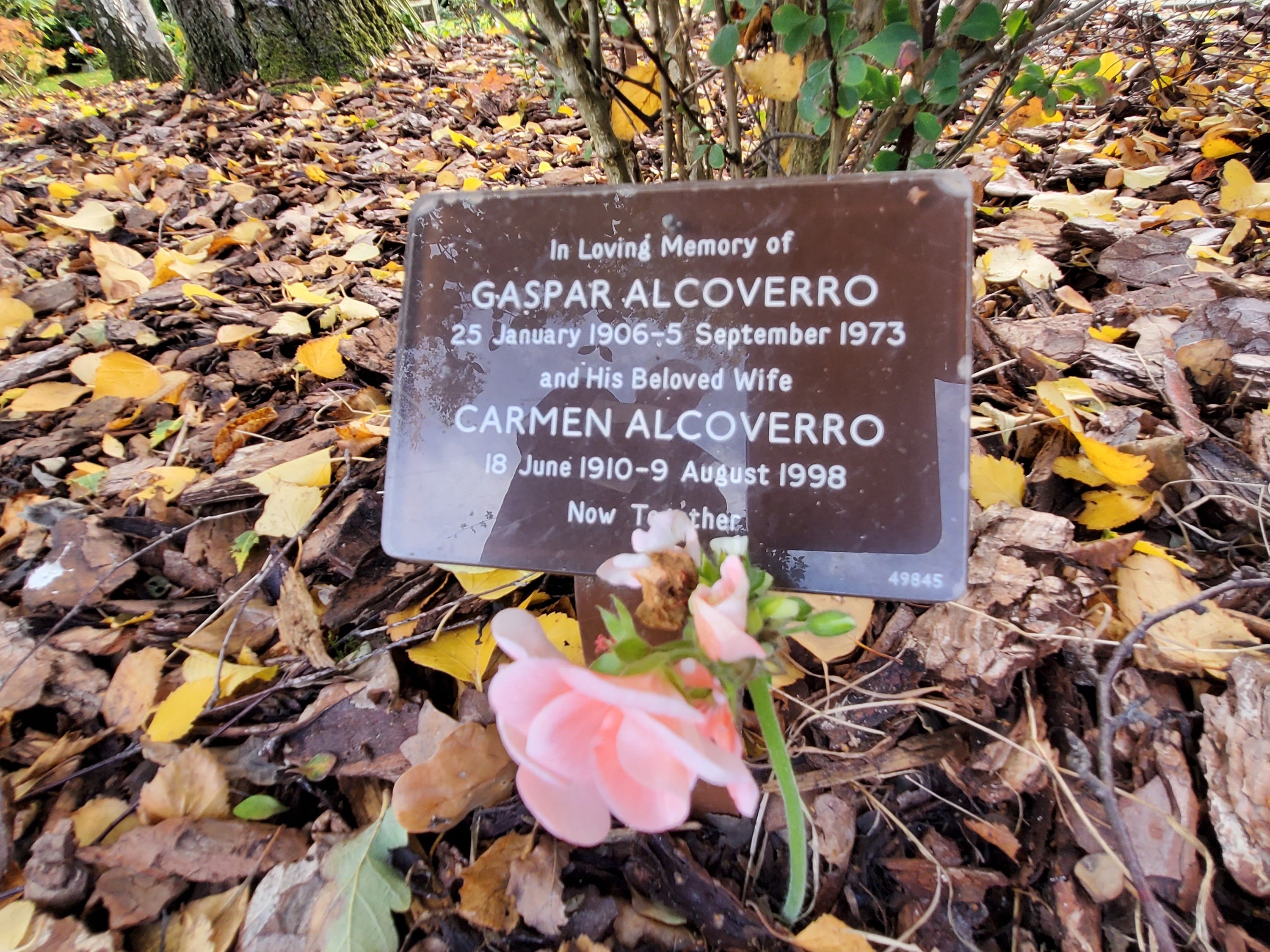
I bent down to clear the leaves so they could read it. We stood there quietly. No speeches. No ceremony. Just three men in North London, connected by a house.
Several weeks after their visit, an email arrived. It was from Jordi. He wrote to explain more who they were and why they had come. They were the nephews of Gaspar Alcoverro i Vallejo, the man who had once lived in our house during his years in exile.
He thanked us for allowing “two perfect strangers” into our home. He wrote that stepping back into the house had brought back vivid memories of childhood, of safety after upheaval, of family reunited after years of separation. For a brief time, he said, the past had felt close again.
Through that letter, the house revealed its history.
Gaspar Alcoverro had been a Catalan nationalist who survived the Spanish Civil War, imprisonment in French concentration camps, and political exile. Branded a “red-separatist” by Franco’s regime, he had been separated from his wife and daughters for nearly a decade while they endured harassment in Barcelona. When they were reunited in London, it was in this house that they rebuilt their lives.
Before the Alcoverro family, the house had belonged to Josep Maria Batista i Roca, a historian and organiser of Catalan resistance abroad. In 1948, this unassuming address became a meeting place for political activity in exile. Funds were raised. Plans were discussed. Culture was defended while it was being suppressed in Spain. From the outside, it was an ordinary semi-detached house. Inside, it carried the quiet work of resistance.
We too had arrived in London as political refugees. We know what it means to leave a country because history pushes you out. We know the weight of rebuilding a life in another language, the long apprenticeship of belonging. Over a decade, we made this flat our home. But the word “home” is never simple when you have left one behind.
Letting them in took only a moment. But it changed how I see the place we inhabit. We believe we own our homes. The lease, the mortgage, the keys suggest permanence. Yet we are only custodians of crossings, temporary stewards of rooms that have sheltered other histories before ours and will do so again after we are gone.
One day, someone else may stand on the pavement looking up at this house with recognition in their eyes. If they knock, I hope someone opens the door.
© Mehrdad Aref-Adib 2026
Framed/Unframed is a reader-supported publication. Your support means a lot. You can become a paid subscriber, or help out for free by liking this post, sharing it, or sending it to a friend.